Office Clearance in Shortlands

Office Clearance Shortlands provides organised removal of unwanted workplace items for businesses that need desks, chairs, filing cabinets, meeting room furniture and general office contents taken away with care. The service is suited to planned moves, refurbishments, lease end clear-outs and regular workplace changes where a tidy handover matters. We handle clearances in a way that keeps the process straightforward for the customer, with practical sorting and removal of items that are no longer needed.
Our work can include single floors, shared offices, storage rooms, reception areas and back-of-house spaces. Where items still have use, they can be separated from general waste streams and handled accordingly. If your office is being reconfigured, cleared for return, or made ready for new tenants, a clear plan helps the job move smoothly. Tell us what needs removing, and we can discuss the most suitable approach for the space.
For customers comparing options, the main decision is often how much has to leave, how quickly the area needs to be cleared and whether the items include heavy or awkward furniture. A useful first step is to identify what should stay and what should go, then note access points, lifts, parking constraints and any timing limits from the building or landlord. That makes it easier to request a quotation that matches the work rather than relying on guesswork.
Office furniture and equipment removal
Desks, task chairs, storage cupboards, conference tables and similar office furniture often make up the largest part of a clearance. These items can be bulky, fixed in place awkwardly or assembled in a way that takes time to dismantle safely. Our office clearance work is designed around removing those items in a controlled order so circulation routes stay manageable while the room is being emptied. The aim is to leave the space ready for its next use without unnecessary disruption.
Beyond standard furniture, offices commonly contain smaller items that still need attention: shelving, noticeboards, small appliances, archived paperwork holders and loose fixtures. We can work through those items alongside the larger pieces so the clearance is not left half done. If your priority is a full room reset, it often helps to separate furniture, equipment and loose contents before the visit. That keeps the removal sequence clearer and makes the outcome easier to plan.
Useful items for a clearance plan often include:
- desks and workstations
- office chairs and visitor seating
- filing cabinets and storage units
- meeting tables and reception furniture
- small office appliances and accessories
Workspace clearances for moves and refurbishments
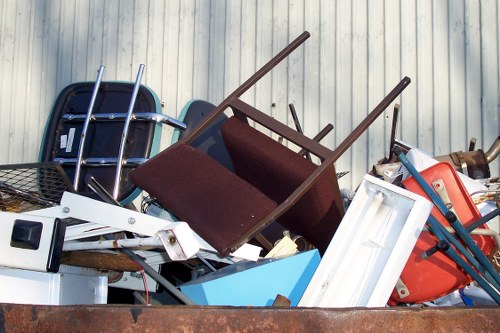
Office moves and internal refurbishments usually require a clearance that is more than simple waste collection. Furniture may need to be taken out in a particular order, items may need separating by floor or department, and the remaining space may need to be kept clear for contractors or decorators. Our service supports those practical requirements by focusing on removal that fits the condition of the workplace on the day. That can be useful where the office is being handed back, re-planned or fitted out again.
Some workplaces need a partial clearance rather than a complete strip-out. For example, an office may be retaining desks but losing old storage, or keeping furniture on one floor while another floor is emptied. In those cases, a careful brief matters more than volume alone. If there are any items that require extra attention because of size, weight or location, include them in the request so the quotation reflects the actual work rather than a simplified assumption.
Preparation need not be complicated, but it should be specific. A short inventory, a note of access arrangements and a basic description of the rooms involved can make a meaningful difference. If there are sensitive items that need to be left in place, or mixed contents that should not be taken with the clearance, state that clearly at the outset. The clearer the brief, the easier it is to match the job to the right plan.
Business waste handling and sorting
Many office clearances include more than furniture. There can be packaging, archived items, broken office accessories, mixed general waste and contents from cupboards or store rooms. Where a workplace clearance involves several different waste types, sorting becomes part of the job itself. Our approach is to separate the material sensibly so the right items are handled together, which is especially useful when the office has accumulated waste over time rather than in a single event.
That sorting step also helps when a business is trying to clear only certain parts of the premises. A server room, stationery store or side office may hold mixed contents that should be removed in a different way from the main desk area. A well-planned clearance allows for those distinctions. It also reduces the chance of items being overlooked or moved unnecessarily, which is important when the space still has staff, contractors or building management activity around it.
We can also support requests where offices contain items that are no longer useful but should not simply be treated as generic rubbish. Older furniture, reusable equipment and mixed contents can be assessed as part of the same visit so the clearance remains orderly. When seeking a quotation, it is useful to distinguish between straightforward waste, reusable office contents and anything that needs extra handling because of location or weight. That helps keep the estimate accurate and practical.
Access, timing and quotation details

Clearance work is often shaped by access rather than by item count alone. Lifts, stairwells, shared corridors, security points and loading arrangements can all affect how an office clearance is organised. If your building has managed access or restricted movement times, it is sensible to include that information when asking for a quote. The more accurately the access is described, the more realistic the plan will be for the work itself.
Timing matters as well, particularly in offices that need to remain partly operational during a clearance. Some jobs can be divided into stages so that essential work continues while redundant items are removed. Other jobs are easier to complete in a single visit once the office has been vacated. Either way, it helps to explain whether the work is tied to an end-of-lease deadline, a refit schedule or a general tidy-up of underused space.
To help with a quotation, it is usually enough to provide a few focused details:
- the rooms or floors involved
- the main types of office contents to be removed
- any access restrictions, parking notes or building controls
- whether the clearance is partial, full or phased
About Shortlands
Shortlands is a suburban district in the London Borough of Bromley, situated between Bromley town centre and Beckenham in south-east London. The area is closely associated with its station, which opened in the nineteenth century and helped shape the surrounding residential growth. Streets around the station show a mix of Victorian and later housing, while the wider district includes quiet residential roads, local shopping parades and school facilities that serve the neighbourhood. The landscape is generally suburban, with mature trees and small pockets of green space creating a calmer character than the busier centres nearby. Shortlands is also linked to the River Ravensbourne corridor, which runs through parts of the borough and forms part of the wider local landscape. The district’s everyday identity is shaped by ordinary but distinctive urban features: rail connections, local community spaces, and the contrast between older building stock and more modern additions. Although it is close to Bromley, Shortlands retains its own identity through its station area, residential streets and local routines. That combination of transport access and settled housing gives the place a recognisable sense of scale, neither central London nor rural fringe, but a compact suburban community with its own long-established pattern of life.
Why businesses choose a planned clearance

A planned office clearance is usually easier to manage than a last-minute removal because it gives the business time to separate what stays from what goes, and to organise the office in the right order. The process can reduce clutter before a handover, support a fit-out project or simply free up rooms that are no longer being used properly. For many customers, the value lies in turning a crowded workplace into a workable space without leaving the sorting burden to staff who already have other duties.
It is also common for offices to contain mixed content that does not sit neatly in one category. A drawer unit may hold stationery, paper archives and obsolete equipment; a store cupboard may include spare seating, packaging and broken accessories. A clearance service needs to deal with the whole picture rather than just the obvious large pieces. That is why describing the contents honestly is more helpful than trying to summarise the job in a single sentence. It lets the scope be set around what is actually present.
When discussing the job, it helps to mention whether the office is still occupied, partly cleared already or completely empty. Those details affect how the work can be sequenced and whether the clearance needs to be coordinated around staff, cleaners, decorators or landlords. Small omissions can change the plan, so a short, accurate description is often more useful than a long but vague one.
Office contents we can clear
Office environments vary widely, but many share a similar mix of contents. A standard clearance may involve individual desks, pedestal units, office chairs, storage cupboards, loose shelving and boardroom furniture. More specialised workplaces may also include archive items, filing systems, partition-related contents and equipment from print or admin areas. Our office clearance service is set up to deal with that kind of varied mixture in a practical and orderly way.
It is important to note that not every item needs the same handling. Some items are straightforward to remove, while others may need dismantling, carrying in sections or moving through tighter access routes. Where a job involves heavier objects, awkward dimensions or items in upper floors, the quotation should reflect that complexity. If there are items that must remain on site, separate them clearly before the clearance begins so there is no confusion at the point of removal.
The same principle applies to contents that are scattered rather than concentrated in one room. Offices often store supplies in cupboards, cabinets, under-desks and side rooms, so a meaningful clearance may need to include those areas as well as the main working floor. If you are unsure how to describe the job, start with the rooms, then list the main objects in each room. That gives a clearer brief and makes the resulting plan much easier to follow.
Working around office handovers and reconfiguration

Office clearances linked to handovers or reconfiguration are usually driven by what the next stage of the property requires. A landlord may expect a cleaner handback, a fit-out team may need open access, or a company may be changing the use of part of the building. In those situations, the clearance needs to be not only efficient but also suitably paced so the workspace is ready for the next team. Our service is arranged around those practical aims rather than a one-size-fits-all approach.
Where the office is being reorganised rather than emptied completely, the clearance may involve selecting specific items for removal while other items remain in place. That can be helpful when a business is consolidating departments, reducing unused storage or replacing old furniture in stages. If you want a quotation for that type of work, it is worth noting which pieces are staying, which are being replaced and which spaces need to remain accessible throughout.
If you are ready to move forward, the next step is simple: send a clear description of the office contents and include the main access details. For a fuller discussion of scope and timing, use our pricing and quotes page, or make an enquiry through our contact us page. A brief message is usually enough to start the conversation and request a quotation.